Brix, Screenly, Xibo, Yodeck, OptiSigns and ScreenCloud are six alternatives to Scala, each with a published price. The reasons teams switch are below, along with what changed when Vertiseit bought Scala.
Who owns Scala, and is it still supported?
Vertiseit bought Scala from STRATACACHE. Vertiseit announced the deal in May 2026 and closed it the following month. Scala is part of Dise, a Vertiseit company. Scala's own site says the company is returning to a software-only, partner-only model, so you buy and get support for the software through a Scala partner.
The hardware side is different. Screenly sells a product that reimages existing Scala players. Screenly says Scala's hardware business is winding down. Screenly also says nobody is building new Scala players.
Why people look for a Scala alternative
- No public price. Scala's own site shows no pricing page; you contact Scala directly for a quote.
- Sold through partners. Scala sells through a partner network rather than direct self-serve sign-up, which adds a step most small and mid-size teams do not want.
- Moving off an on-premises base. Scala's own site says it is "accelerating the transition to modern cloud-based software and recurring SaaS services," which signals a lot of its installed base still runs the older on-premises way.
- Aging player hardware. Screenly, which sells a product that reimages existing Scala players, says Scala's hardware business is winding down and nobody is building new Scala players.
Scala alternatives compared
| Platform | Price (per screen/month) | Players | Best for |
|---|---|---|---|
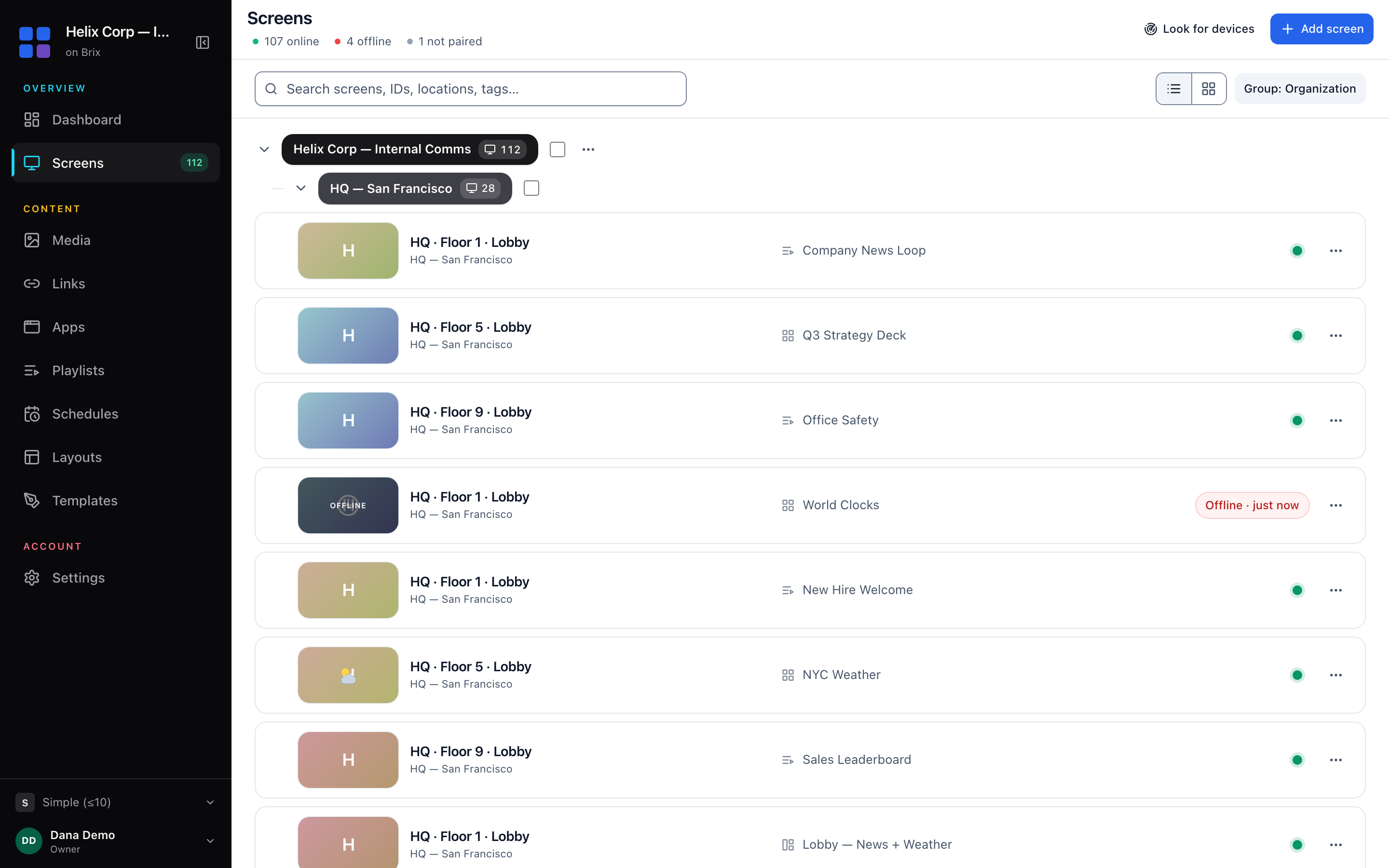
| Brix | $6 annual, $8 monthly | Amazon Signage Stick, Fire TV, Android TV, Windows | Cloud-first teams replacing Scala without hiring IT to run it |
| Screenly | $15 annual, $17 monthly | Screenly players, reimaged Scala players, Screenly Anywhere (Android, ChromeOS, Stick) | Keeping existing Scala hardware running past its vendor support |
| Xibo | GBP only, from £3.50 | Self-hosted server, or Xibo's hosted CMS; Android, webOS, Tizen, ChromeOS, Windows | Staying on your own servers, the way Scala originally worked |
| Yodeck | $8 annual or monthly (Basic) | Signage Stick, Fire TV, Tizen, webOS, BrightSign, Windows, Yodeck's own player | Large fleets that mix several hardware platforms |
| OptiSigns | $9 annual, $10 monthly (Standard) | Amazon Signage Stick, Android, Windows, OptiSigns hardware | App-heavy screens, with a 3-screen free tier to pilot first |
| ScreenCloud | $20 annual, $24 monthly (Core) | ScreenCloud OS player, PIXI, Android boxes | Internal-communications-led teams at a larger company |
Scala itself has no row here: it publishes no price to compare. For a larger rollout, also see enterprise digital signage platforms.
The alternatives, one by one
Brix
Price: $6 per screen per month, billed annually, or $8 billed monthly. 7-day free trial, no card. Best for: A Scala replacement that a small team can run without dedicated IT, with the Amazon Signage Stick as the default hardware. Players: Amazon Signage Stick, Fire TV, Android boxes (including the Walmart Onn), TVs with Google TV or Android TV built in, and the Windows player. Strengths: One plan, every feature, no quote needed. Brix places a new workspace's media, database and live connection in the region it signs up from (US, EU, Oceania or Asia-Pacific), which an enterprise IT reviewer coming from Scala's on-premises world will ask about. Setup for the Signage Stick takes about 10 minutes. Watch out for: No on-premises or self-hosted CMS. Brix Edge, a free server you run on your own network, keeps documents there, but that covers one use case, not a general on-premises option. No SAML (OpenID Connect only). No synced video wall across multiple screens.
Screenly
Price: $15 per screen per month billed annually, $17 billed monthly (Starter, up to 5 screens); $24 annual / $27 monthly from 5 screens (Business); $38 annual from 25 screens (Enterprise). Best for: A business that already owns Scala media players and wants to keep them instead of buying new hardware. Players: Screenly's own players (Screenly Player, Screenly Player Max), reimaged Scala players running ScreenlyOS, and Screenly Anywhere, an app for Android, ChromeOS, Samsung Tizen and the Amazon Signage Stick. Strengths: A free migration assessment and a 30-day pilot on up to ten players, with content cached locally so a screen keeps playing if the connection drops. You can run reimaged Scala players and Screenly's own hardware in one fleet while old units fail over time. Watch out for: This replaces Scala's software, not its sales model: you are still buying a subscription per screen. It does not remove the hardware eventually, it just extends its life.
Xibo
Price: No USD price published. Hosted plans are GBP only: Professional from £3.50, Business £5.50, Enterprise £9.00 per display per month. Self-hosting needs player licences (Android £20, webOS/Tizen £60, ChromeOS £35 one-time; the Windows player is free). Best for: A team that must keep the CMS on its own server, the way Scala was originally built. Players: Self-hosted CMS with Android, webOS, Tizen, ChromeOS and Windows players, or Xibo's own hosted cloud plans. Strengths: The CMS is open source (AGPLv3) and free to self-host; the Windows player is free either way. It is the closest match here to Scala's original on-premises model, for a team with the same willingness to run its own servers. Watch out for: Self-hosting adds the work a cloud platform usually removes: your own server, backups, CMS updates and security patches, with community support instead of a vendor to call. The hosted plans bill in GBP only; everything else on this list bills in USD.
Yodeck
Price: $8 per screen per month, the same rate billed monthly or annually (Basic); $12 (Premium); $16 (Enterprise). Best for: A large fleet that already runs a mix of hardware and needs one CMS across all of it. Players: Amazon Signage Stick, Fire TV, Tizen, webOS, BrightSign, Windows, and Yodeck's own player (free with an annual plan). Strengths: An established company (180-plus people) with support for more player hardware than most options here, which matters if a Scala fleet is already mixed. Watch out for: Custom roles that restrict who can publish content sit on the Enterprise plan only, so the feature that replaces a Scala approval workflow costs more than the entry price suggests. Yodeck hosts in the EU only.
OptiSigns
Price: $9 per screen per month billed annually, $10 monthly (Standard); up to $45 monthly / $40.50 annually on Enterprise (25+ screens). Best for: A team that wants a large app library and a free tier to test before committing. Players: Amazon Signage Stick, Android, Windows, and OptiSigns' own player hardware. OptiSigns is phasing out support for Fire TV devices. Strengths: A free plan for up to 3 screens to pilot content before paying anything, and a wide app library so most screen types need no custom build. Watch out for: The free plan puts the OptiSigns logo on screen and caps storage at 1 GB. The features closest to Scala's enterprise controls (roles, approvals, audit log) sit on the Pro Plus plan and above, not the entry price.
ScreenCloud
Price: $20 per screen per month billed annually, $24 monthly (Core); $30 annual / $36 monthly (Pro); Enterprise has no public price. Best for: A larger organization whose signage project is run by the internal-communications team rather than IT. Players: ScreenCloud OS player, PIXI, Android boxes. Strengths: Built around communications use cases (announcements, dashboards, recognition) rather than pure digital-out-of-home advertising, which fits a Scala deployment that was really an internal comms network. Watch out for: The entry price here is the highest of the cloud options in this list, and Enterprise pricing is a quote, same as Scala.
Moving off Scala
See how to switch digital signage providers for the general steps. If you choose Brix, migration is free, usually in a day: Brix moves your content, playlists and screens for you. For a rollout of 30 or more screens, Amazon provides Signage Sticks free; contact Brix through a demo and Brix arranges it with Amazon, so hardware is not the thing that holds up the switch.
Is there a free alternative to Scala?
Scala itself has no free tier. Among the alternatives here, Yodeck's single-screen plan is free forever, and OptiSigns gives you 3 screens free, with its logo shown on screen. Brix runs a 7-day free trial with no card, which is enough time to pair a Signage Stick and build a real playlist, but it is not a permanently free tier.
What does Scala digital signage cost?
Scala publishes no public price. Its own site shows no pricing page or plan list; it asks you to contact Scala about your project instead. Capterra's listing for Scala shows a starting price of $200 a month. Scala itself does not publish that figure. Ask Scala, or one of its partners, for a quote based on your screen count, hardware needs and whether you want managed services.
Does Brix support on-premise like Scala?
No. Brix is cloud only; there is no self-hosted or on-premises version. What Brix offers instead is hosting-region placement: a new workspace's media, database and live screen connection sit in the US, EU, Oceania or Asia-Pacific, based on the country you sign up from, at no extra cost on any plan. The EU is the only one of those with a contractual data jurisdiction; the others are placement, not a guarantee.
Can I keep running my existing Scala media players?
Screenly is the only alternative here that advertises reimaging existing Scala players, through ScreenlyOS. The others on this list do not advertise a path for Scala players; on Brix the usual player is the $99.99 Amazon Signage Stick.